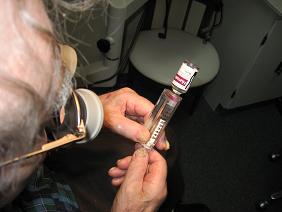
New Dual-Magnification Telescopic Eyeglasses treat vision loss due to macular degeneration and low vision. They have the potential to return reading, writing, and hobby ability for some of those who have been told by their eye doctor "sorry I cannot make your glasses stronger".
 |
Dual-Magnification Telescopic Eyeglasses
for macular generation and low vision |
Low vision is a reduced vision condition that
cannot be corrected by regular glasses, medicine or surgery. Dr. Randolph Kinkade, a Connecticut optometrist and founding member of the International Academy of Low Vision Specialists, designs high-power glasses to help
those who are no longer able to see and do the things they like to do.
Dr. Kinkade has coined the term, Dual-Magnification Telescopic Eyeglasses, to describe what these glasses are capable of doing.
As eyesight changes for people with healthy eyes, new glasses are prescribed to restore
20/20 vision. This is not the case with
advancing macular degeneration and other vision limiting conditions like
glaucoma, diabetic retinopathy and optic nerve disease. Eyesight can no longer be improved to 20/20 vision.
Dr. Kinkade's low
vision glasses do make things larger so you can see better. Depending on the patient's level of vision, they can sometimes give the affect of 20/20 vision. To read the newspaper a 20/40 affect is best. For large print a 20/60 affect is needed. Telescopic glasses magnify enough to move the image to healthier parts of the retina improving your ability to see better. Not perfect, but definitely better.
It
is important for the patient to come to the office with specific tasks on a
“wish list” that they want to try to see better While not every activity on the wish list
can be achieved, we do not know until we try.
For people with low vision regular glasses are no longer effective for seeing what needs to be seen and then that is when their eye doctor often says "sorry changing your prescription will not help you".
Regular glasses only focus the image into the macula in the back of the eye. They do not provide the magnification that is needed for someone with low vision.
The magnifying telescopes allow for an enhanced power and improved viewing distance when compared to regular glasses. The dual power allows for different strengths to be placed in the same telescope. For example, the top portion can be used for looking at cards on the table and the bottom portion can be use for looking at cards in your hand. In essence this is a telescope with bifocal action.

Different tasks require different powers. Looking at a still life across the room requires different magnifying power than seeing what is being painted on the canvas.
Piano music is at a different distance than the piano keys, and therefore, requires different magnification and focal length lenses.
Reading a newspaper on the table requires different power and viewing distance than taking out a sliver from a finger.


A computer monitor is often a different distance than the computer keyboard. Magnification needs depends on the size of the monitor and font being viewed.
These special eye glasses do make vision better, not perfect. How much better? That depends on the level of vision, what you want to see and do, and your ability to adapt to new ways of seeing.
The telescopic glasses can be fitted in front of one or both eyes depending on the level of usuable vision and the visually-guided task at hand.
To
learn more about these special glasses please visit Dr. Kinkade’s website. www.LowVisionEyeGlasses.com
You may email Dr. Kinkade with your questions.
rkinkade@optonline.net
You are also welcome speak
to Dr. Kinkade during a free telephone consultation to see if you or someone you know is a candidate for telescopic glasses.
(800) 756-0766
Offices Throughout Connecticut
Cheshire - Danbury - Farmington
- Litchfield - Manchester - Norwalk - Waterford


.JPG)