Monday, April 22, 2013

Macular Degeneration Low Vision Treatment in Connecticut


Prismatic Magnifying Readers (PMRs) and Spectacle Miniature Telescopes (SMTs) treat macular degeneration and other vision loss conditions (low vision).  Dr. Randolph Kinkade, a Connecticut optometrist and founding member of the International Academy of Low Vision Specialists, understands how to maximize eyesight when there has been permanent vision loss.


Low vision can make daily activities such as reading the newspaper, writing a check or driving the car difficult or impossible.   With low vision, the vision loss cannot be corrected completely with regular glasses, surgery or medication. 

Macular degeneration is the most common cause of low vision.  However, other eye conditions such as glaucoma, diabetic retinopathy, optic nerve disease, eye injuries and birth defects can lead to permanent vision loss.  This vision loss can be mild to severe. 

Low vision means people have to change how they do things.  Special low vision glasses (high-power and telescopic), large print, video magnification and special software are devices to help with vision loss.

“Magnification is the key to low vision treatment”, said Dr. Kinkade. “Magnification in the form of glasses, rather than having to hold a magnifier, is the ideal goal for low vision rehabilitation”.

There are limits to how much effective magnification a regular pair of glasses can deliver.  The more magnification that is required to read, the closer the reading material must be held to the glasses.

Prismatic Magnifying Readers describe glasses coined by Dr. Kinkade.  They offer increased magnification while allowing both eyes to work better together for additional enhancement.   The vision needs to be relatively equal in both eyes for PMRs to be most beneficial.  These glasses reduce the eye strain and fatigued often accompanied when reading material must be held close.  Holding reading material close allows for the extra magnification.


Spectacle Miniature Telescopes (SMTs), also a term coined buy Dr. Kinkade, offer magnification at a more normal reading distance.  SMTs use 2-3 lenses in combination to provide the power and increased viewing distance.  They can be fit for one or both eyes.   They can be helpful for seeing playing cards on the table, reading piano music, or painting. They can also be useful for distance magnification for seeing faces, television, and road signs.


“Due to laws of optics and physics and the anatomy of the eye, as magnification increases the field of view decreases”, said Dr. Kinkade.  “When the field of view deceases, less of the page can be seen at a time.  This means that the patient must learn to scan more across a line of print when reading”.

Proper and enhanced illumination is the other major assistive treatment for low vision. 
“High magnification and better illumination is often the difference between reading and not being able to read with low vision” said Dr. Kinkade.


About Dr. Randolph Kinkade
 
 
Dr. Kinkade is a Fellow of the American Academy of Optometry Low Vision Section and a member of the Vision Rehabilitation Section of the American Optometric Association.
 
Dr. Kinkade has a master of public health degree (MPH) from the University of Connecticut where he concentrated his studies on the prevalence and treatment of low vision.
 
He has offices throughout Connecticut: Cheshire, Danbury, Farmington, Litchfield, Manchester, Norwalk and Waterford.


Doctor Screens Macular Degeneration Patients for New Implantable Telescope Treatment

Four patients have been screened in Connecticut to determine if they are candidates for the Implantable Miniature Telescope (IMT) for treating advanced macular degeneration reports Dr. Randolph Kinkade, optometrist and founding member of the Academy of Low Vision Specialists.

The telescope is planted in only one eye replacing some of the lost central vision.   There is no telescope implanted in the other eye since it is used for the peripheral vision. After surgery the patient undergoes several months of training to learn how to use the new vision.

                                                 WFSB Television Dr. Kinkade Interview


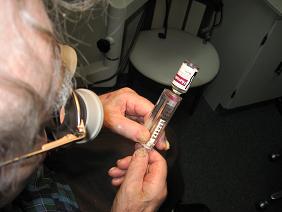
Dr. Kinkade holding the IMT


To learn more about the IMT please visit Dr. Kinkade’s website. www.LowVisionEyeGlasses.com

You may email Dr. Kinkade with your questions.
rkinkade@optonline.net

You are also welcome to speak to Dr. Kinkade during a free telephone consultation to see if you or someone you know is a candidate.
(800) 756-0766
Offices Throughout Connecticut

Cheshire - Danbury - Farmington - Litchfield - Manchester - Norwalk - Waterford


New Macular Degeneration Glasses Treatment Now Available

New Dual-Magnification Telescopic Eyeglasses treat vision loss due to macular degeneration and low vision.  They  have the potential to return reading, writing, and hobby ability for some of those who have been told by their eye doctor "sorry I cannot make your glasses stronger".


Dual-Magnification Telescopic Eyeglasses
for macular generation and low vision
Low vision is a reduced vision condition that cannot be corrected by regular glasses, medicine or surgery.   Dr. Randolph Kinkade, a Connecticut optometrist and founding member of the International Academy of Low Vision Specialists, designs high-power glasses to help those who are no longer able to see and do the things they like to do.


Dr. Kinkade has coined the term, Dual-Magnification Telescopic Eyeglasses, to describe what these glasses are capable of doing.
 
As eyesight changes for people with healthy eyes, new glasses are prescribed to restore 20/20 vision.  This is not the case with advancing macular degeneration and other vision limiting conditions like glaucoma, diabetic retinopathy and optic nerve disease.  Eyesight can no longer be improved to 20/20 vision.

Dr. Kinkade's low vision glasses do make things larger so you can see better.  Depending on the patient's level of vision, they can sometimes give the affect of 20/20 vision.  To read the newspaper a 20/40 affect is best.  For large print a 20/60 affect is needed.  Telescopic glasses magnify enough to move the image to healthier parts of the retina improving your ability to see better.  Not perfect, but definitely better.


It is important for the patient to come to the office with specific tasks on a “wish list” that they want to try to see better   While not every activity on the wish list can be achieved, we do not know until we try.
 
For people with low vision regular glasses are no longer effective for seeing what needs to be seen and then that is when their eye doctor often says "sorry changing your prescription will not help you".

Regular glasses only focus the image into the macula in the back of the eye.  They do not provide the magnification that is needed for someone with low vision.


The magnifying telescopes allow for an enhanced power and improved viewing distance when compared to regular glasses.  The dual power allows for different strengths to be placed in the same telescope.  For example, the top portion can be used for looking at cards on the table and the bottom portion can be use for looking at cards in your hand.  In essence this is a telescope with bifocal action.  


Different tasks require different powers.  Looking at a still life across the room requires different magnifying power than seeing what is being painted on the canvas.
 
Piano music is at a different distance than the piano keys, and therefore,  requires different magnification and focal length lenses.
 
Reading a newspaper on the table requires different power and viewing distance than taking out a sliver from a finger.


A computer monitor is often a different distance than the computer keyboard.  Magnification needs depends on the size of the monitor and font being viewed.
 
These special eye glasses do make vision better, not perfect. How much better? That depends on the level of vision, what you want to see and do, and your ability to adapt to new ways of seeing.

 
The telescopic glasses can be fitted in front of one or both eyes depending on the level of usuable  vision and the visually-guided task at hand.

To learn more about these special glasses please visit Dr. Kinkade’s website.  www.LowVisionEyeGlasses.com

You may email Dr. Kinkade with your questions.
rkinkade@optonline.net

You are also welcome speak to Dr. Kinkade during a free telephone consultation to see if you or someone you know is a candidate for telescopic glasses.
(800) 756-0766

Offices Throughout Connecticut

Cheshire - Danbury - Farmington - Litchfield - Manchester - Norwalk - Waterford


Tuesday, April 16, 2013

Low Vision Magnification in Connecticut for Macular Degeneration

Dr. Randolph Kinkade, Connecticut optometrist and founding member of the International Academy of Low Vision Specialists, has been treating macular degeneration for over 30 years with high power and telescopic eyeglasses.  These special glasses provide the necessary magnification to help some ability to read by moving the image of what is being viewed to healthier parts of the macula and retina.


The Implantable Miniature Telescope (IMT) is another alternative to improve vision suffering from macular degeneration.  This is a new surgical option for patients with advanced macular degeneration, who up to now have had limited options for improving vision.  It offers new hope.


The implant is smaller than the tip of a pencil erasor and uses micro-technology to magnify images that would have normally fallen on the blind spot in vision created by macular degeneration. 


Macular degeneration is a disease that affects the macula in the center of the the back of the eye.  A healthy macula helps deliver detail vision to the brain.  The loss of the macula's ability to "see"  makes it hard or very difficult to read, write, drive, or recognize faces clearly.  Macular degeneration affects both eyes, although one eye may be more impaired than the other.

Patients tell me "my center vision is obstructed...if I could only see through that veil".


(800) 756-0766


Cheshire - Danbury - Farmington - Litchfield - Manchester - Norwalk - Waterford

Macular Degeneration Low Vision Treatment Videos

Dr. Randolph Kinkade, a Connecticut optometrist and founding member of the International Academy of Low Vision Specialists, shares his educational videos.

Low Vision is a condition where regular glasses can no longer improve vision to a level that allows you to see and do the things you like to do.  Macular Degeneration is the most common cause of low vision.

Low Vision can be treated with:
1. Spectacle Miniature Telescopes
2. Implantable Miniature Telescopes
3. Prismatic Magnifying Eyeglasses
4. Microscopic Reading Eyeglasses
5. Optical Magnifiers
6. Electronic Magnifiers


Spectacle Miniature Telescopes for Low Vision


Implantable Miniature Telescope


(800) 756-0766


Cheshire - Danbury - Farmington - Litchfield - Manchester - Norwalk - Waterford

Sunday, March 24, 2013

New Implantable Telescope to Treat Macular Degeneration in Connecticut

Dr. Randolph Kinkade, Connecticut optometrist and founding member of the International Academy of Low Vision Specialists, is part of  the doctor team offering a new treatment for macular degeneration patients in Connecticut.


Dr. Randolph Kinkade during an IMT interview.


Link to Television Interview

 
The Implantable Miniature Telescope (IMT) technology reduces the impact of vision loss due to advanced macular degeneration.  The telescope projects the objects the patient is looking at onto healthier areas of the light-sensing retina in the back of the eye not degenerated by the disease.


Macular Degeneration is the leading cause of vision loss in seniors.  There are approximately two million senior Americans who have the advanced form of this disease affecting the central region of the retina called the macula.  The macula is responsible for detailed vision like reading, writing, watching television, seeing faces and driving.
 
Dr. Kinkade has been fitting Spectacle Miniature Telescopes (SMTs) for over twenty years.  These special glasses have prescriptions built into tiny telescopes mounted into eyeglasses.


An Implantable Miniature Telescope next to a Spectacle Miniature Telescope.


The U.S. Food and Drug Administration approved the IMT in 2010.  The surgical procedure involves removing the eye's natural lens that has a cataract and replacing the lens with the telescope implant. The tiny telescope is implanted behind and through the pupil.
 
Looking through a miniature telescope.
 
 
"While it doesn’t cure macular degeneration, it will help improve the vision of patients and help maximize their vision," said Dr. Kinkade.   It will help them resume some of their favorite activities and regain independence".
 
The  telescopic implant costs approximately $15,000.  That does not include the cost of surgery and rehabilitation. The IMT is covered by Medicare for eligible patients. 
 
"After the  implantation, patients enroll in an extensive rehabilitation program that involves training them to use the device", said Dr. Kinkade.  "Rehabilitation takes about six months to a year is a very critical component."


Dr. Kinkade looking through an External Telescopic Simulator.
 
 
Patients must reteach their brain to see differently.  The eye with the implant see things larger and centrally.  The other eye see things their normal size and peripherally.  This is  unique and different way of seeing.
 
Dr. Kinkade cautions the surgery is for select individuals.   Candidates must be 75 years of age or older, have dry macular degeneration  and no longer be a candidate for drug treatments. Patients are excluded if they have had previous cataract surgery in the eye to be implanted.   There are additional eye shape and eye health requirements.
 
There is good news for patients who are not candidates for the IMT, because they are quite often candidates for the SMT.
 
Dr. Kinkade and patient wearing a Spectacle Miniature Telescope.
 
 
(800) 756-0766


Cheshire - Danbury - Farmington - Litchfield - Manchester - Norwalk - Waterford


Thursday, March 21, 2013

Macular Degeneration Low Vision Treatment in Connecticut


A person is considered to have "low vision" when they can no longer see well enough to do the things they need and like to do.  Low vision cannot be corrected by regular glasses, medicine or surgery.  Low Vision Rehabilitation is a branch of medicine helping patients maximize their vision with special glasses and adaptive aids.

Age-related macular degeneration is a progressive sight robbing disease.  Not only can the disease affect the eyes, it can cause a reduced quality of life and depression.

Age-related macular degeneration affects around 8 million Americans.  It can begin around the age of 50 and about 10 percent of patients have the condition by age 75.  This number increases to 30 percent by the age of 85.

Blurred vision is usual symptom of this disease and it may affect near vision tasks first.


Near Vision: reading - writing - computer - card playing - knitting

Far Vision: television - theater - faces - scenery

 
For macular degeneration the best low vision rehabilitation options are Spectacle Miniature Telescopes, Prismatic Glasses, Implantable Miniature Telescopes and Electronic Magnification Aids.
 
Examples of Spectacle Miniature Telescopes


 Examples of Prismatic Glasses


Examples of Implantable Miniature Telescopes


Examples of Electronic Magnification Aids


Dr. Kinkade has been featured on:


Dr. Kinkade has low vision offices throughout Connecticut: Cheshire, Danbury, Farmington, Litchfield, Manchester, Norwalk and Waterford.  Please call for a telephone consultation to see if you or someone you know is a candidate for any of these rehabilitation options.